





Romina Boccia and Tyler Turman
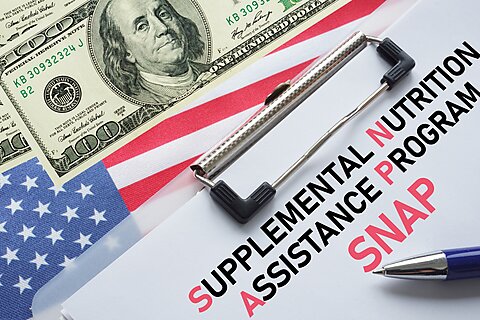
The Republican Study Committee (RSC) released a framework last week for a second reconciliation bill to improve affordability and reduce wasteful government spending. The framework’s reforms to the Supplemental Nutrition Assistance Program (SNAP) aim to tighten eligibility and verification standards with important changes that Congress should seriously consider. But the proposal does not go far enough.
The most structurally sound approach to addressing waste and fraud in SNAP is to end federal financing of benefits and leave nutrition assistance to states that choose to operate such programs using state funds.
A gradual withdrawal of federal SNAP funding could save taxpayers more than $400 billion over 10 years.
What the RSC Framework Gets Right
The RSC framework offers several strong proposals that Congress should implement. These include:
- Eliminating broad-based categorical eligibility (BBCE). States have used BBCE to bypass federal law by extending SNAP benefits to households that don’t meet the program’s statutory income and countable asset limits. The Foundation for Government Accountability estimates that 5.9 million otherwise ineligible people—including people with six-figure assets, lottery winners, and millionaires—are on SNAP through BBCE. In addition, BBCE is more susceptible to payment errors than traditional eligibility, as many states have used it to streamline program administration by weakening their verification protocols. The RSC estimates that closing this loophole would yield $100 billion in spending reductions over 10 years. A policy similar to Representative Ben Cline’s (R‑VA) No Welfare for the Wealthy Act (H.R. 416) would eliminate BBCE and require all households on SNAP to meet the program’s federal income and asset requirements.
- Making noncitizen foreign nationals ineligible for SNAP and other means-tested programs. In fiscal year 2023, 1.764 million noncitizens received SNAP benefits. Current law limits noncitizen SNAP eligibility primarily to lawful permanent residents after a five-year waiting period, assuming they meet SNAP’s eligibility requirements. Barring noncitizens from welfare benefits, as Representative Randy Fine’s (R‑FL) No Welfare for Non-Citizens Act (H.R. 6854) would do, would address voter concerns about immigrant welfare use and accelerate intergenerational mobility among immigrants. The RSC estimates that this will yield $231 billion in spending reductions over 10 years.
- Eliminating SNAP’s quality control (QC) tolerance threshold. SNAP’s QC error tolerance threshold excludes errors below $58 (in FY 2026) from official payment error rates. A Government Accountability Office analysis found that errors below that threshold accounted for 38 percent of misspent SNAP dollars in the cases it reviewed in FY 2013. The RSC’s proposed zero-tolerance QC policy would provide a more accurate measure of SNAP’s improper payments by counting all errors toward a state’s official payment error rate. Representative Randy Feenstra’s (R‑IA) Snap Back Inaccurate SNAP Payments Act (H.R. 762) would implement this by lowering SNAP’s QC tolerance threshold to $0.
- Expanding the use of the National Accuracy Clearinghouse (NAC) to other federal and state programs. The NAC is an interstate data-matching system that prevents individuals from receiving SNAP benefits in multiple states. This is a recurring issue noted by US Department of Agriculture Secretary Brooke Rollins, with 500,000 Americans in 28 states receiving benefits in more than one state. The RSC’s proposal to cross-check NAC data would help prevent duplicative enrollment in other programs, such as Medicaid and Temporary Assistance for Needy Families (TANF). The RSC estimates that this, coupled with a zero-tolerance QC policy, would reduce spending by $7.4 billion over 10 years.
How Congress Can Take SNAP Reforms Further
The RSC’s framework is a good start, but it leaves other SNAP reforms on the table, including omissions that the committee championed in last year’s budget:
- Rescinding the Biden administration’s Thrifty Food Plan (TFP) reevaluation. The 2021 TFP reevaluation violated congressional spending authority and a 45-year cost-neutral precedent by allowing the TFP’s costs to rise above inflation, thereby raising SNAP benefits by more than 20 percent. The One Big Beautiful Bill Act requires future revaluations to be cost-neutral, but it left hundreds of billions in savings on the table by failing to rescind the 2021 increase. Failing to repeal this unlawful expansion left up to $274 billion in 10-year savings untouched.
- Converting SNAP into a discretionary block grant. The RSC’s previous proposal would have used TANF as a model for making SNAP a block grant, coupled with a state cost-share arrangement. This would curb the program’s federal spending growth and give the states greater flexibility to tailor eligibility rules and benefit levels to fit local needs and experiment with new program designs. Additionally, having states share more of the program’s expenses would give them the incentive to clamp down on waste and fraud and reduce caseloads by connecting recipients to work.
The RSC seeks to combat fraud and waste in SNAP by tightening eligibility requirements and verification standards.
But the underlying problem is not a lack of rules. It’s misaligned incentives. As Minnesota’s multibillion-dollar fraud scandal exemplifies, so long as states administer programs they don’t pay for, they’ll have little motivation to prevent improper payments and curb inefficiencies. SNAP is no exception.
States currently share half of SNAP’s administrative costs with the federal government but pay for none of the benefits, which account for more than 90 percent of the program’s total costs (Figure 1).
States run food stamp programs funded almost entirely by federal taxpayers while bearing little financial responsibility for improper payments.
A more incentive-aligned approach would devolve nutrition assistance to the states, allowing them to determine whether and how to operate such programs using state funds. When states finance benefits directly, the costs of waste and fraud fall on state budgets. This strengthens their incentives not only to run programs efficiently but also to design assistance in ways that promote self-sufficiency, work, and long-term independence rather than continued reliance on federal benefits.
The RSC’s proposals offer promising reforms to improve SNAP’s integrity. But unless Congress changes who bears the cost of failure, more federal oversight will only treat the symptoms rather than address the underlying incentive problems that allow financial misuse to persist at the scale we see today.